

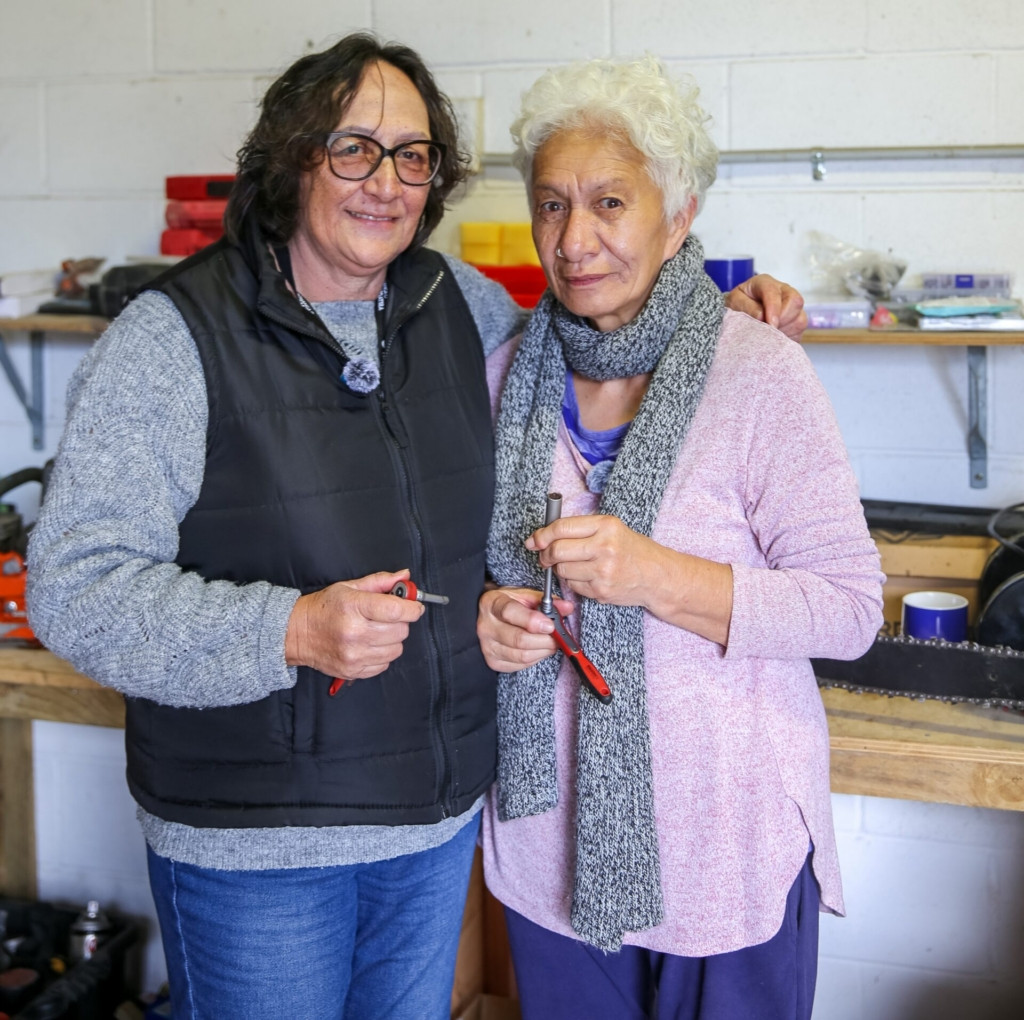
(Left to right) Sue Nepe, Hana Fox
At 69 and 72 years old, Sue Nepe (Ngāti Toa) and Hana Fox (Ngāti Porou, Ngāti Tainui) are showing that learning doesn’t stop at retirement. Through EIT Ruatoria’s Auto Engineering course, they’re gaining practical skills, building confidence and challenging perceptions about who vocational education is for.
For retirees Sue and Hana, returning to education wasn’t on the cards, but a change in circumstances meant they needed practical skills to manage their rural properties and become more self-sufficient.
Hana completed a carpentry course at EIT more than 20 years ago, so she is no stranger to tertiary education. But after losing her husband, and later her partner, she became the main person maintaining her property and responsible for all repairs.
“They were both doers, diving in and fixing things, cutting down trees, managing the water pump, and I realised I need to upskill so I can maintain my own lawn mower, fix a chainsaw or change oil filters on my car.”
Sue’s reason for studying is more focused on the future: if her husband passes or becomes physically unable to do the mahi, she will be responsible for maintenance and repairs.
“When my husband eventually goes, I’m going to have to check the water tank, cut the firewood and keep the house running.”
Sue spent her entire working life in an office, retiring at 67. Retirement felt daunting, but she always had her sights set on learning at EIT.
“I used to see things about EIT and thought I’d really love to do a course, but it was out of my comfort zone.” – Sue Nepe
It took two years for Sue to overcome her fear and find the courage to walk through the doors of EIT Ruatoria, and today she’s confidently learning how to tackle practical tasks she never thought she’d do.
“We’ve learnt how to service a chainsaw, take it all apart, clean it and put it back together, sharpen the chain. And to sharpen lawn mower blades and harden them.”
Another barrier for Sue was worrying that, as an older ākonga, she would be out of her depth.
“I was the more mature person, and you sort of relate someone doing these types of courses with the younger generation.”
But age is no barrier in the workshop, and intergenerational learning is encouraged and applauded. Kuia in their seventies are learning alongside rangatahi fresh out of high school, and Sue has enjoyed forming unexpected friendships and opportunities for shared learning.
“The young ones are just great, we all tend to get on really well, they can come to us, and we can go to them and ask about different skills.”
Sue appreciates the knowledge being exchanged and is passing her new skills on to whānau.
“The other day I told my grandson I’m learning to service a chainsaw, and he thought it was great that his nan is learning these new skills. If I can give back and he’s got his own skills to give back to whānau, it shows the different levels of learning.”
For Sue and Hana, having courses available locally in Ruatoria has made study possible. As Sue explains, Gisborne just wasn’t an option for her.
“Gisborne is one and a half hours away, and I wasn’t up to travelling that far, so this was the only option.”
These kuia are breaking age stereotypes and proving that learning is for life. Hana believes there is still plenty of personal growth and development to be had after retirement.
“I’m 72 in October, but you’re never too old to learn new things. It’s exciting because it means the brain’s still working, it’s always a work in progress. The other important thing is to keep an open mind, because that’s how you learn, otherwise you’re missing out on opportunities to pass your knowledge on to others.”